
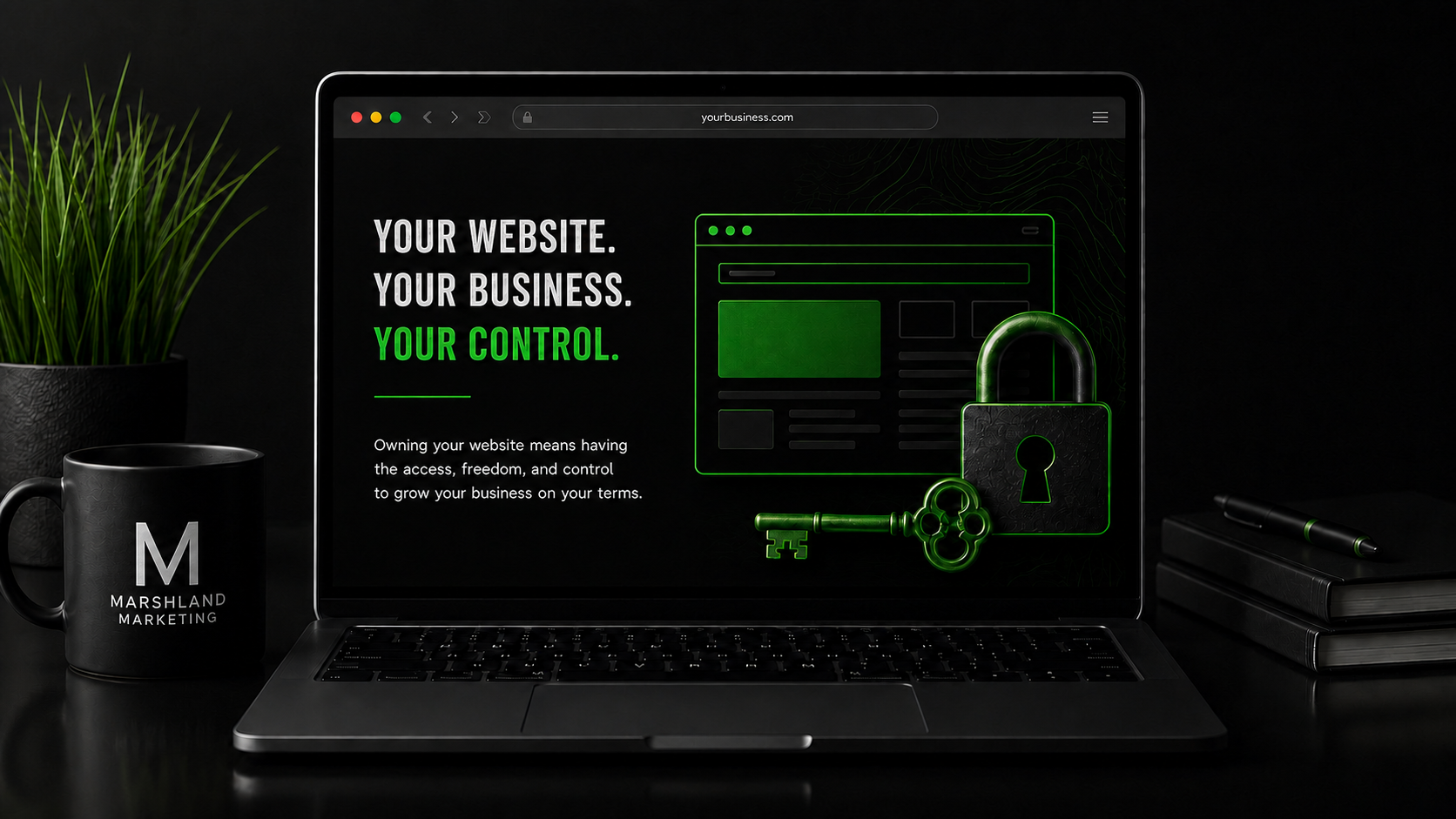
You Built a Website. But Do You Actually Own It?
You paid for the website. Your business name is on it. You have a login. It lives at your domain.
So, you own it. Right?
Maybe.
Website ownership is one of those things nobody thinks much about until they want to move their site, change providers, hire someone new, or simply get access to something they assumed belonged to them all along.
That’s usually when things get interesting.
A Login Isn’t the Same as Ownership
There are plenty of ways to build a website today. Traditional WordPress, hosted website builders, proprietary platforms, AI-powered builders—the list keeps growing.
Some are fantastic tools. Some make getting online ridiculously easy. But convenience and ownership aren’t the same thing.
If your website exists entirely inside a company’s proprietary system, you may have complete control over what the site says and how it looks while you’re using that service. What you may not have is a website you can simply pick up and move somewhere else.
Think of it a little like renting a furnished apartment.
You can move the furniture around. You can decorate. You might absolutely love living there.
But you can’t necessarily load the apartment itself onto a truck when you leave.
What Should You Actually Have Control Of?
For a typical business website, there are a few separate pieces that are easy to lump together as “the website.”
Your domain name is your address on the internet. You should know where it’s registered and how it’s managed.
Your DNS tells the internet where services connected to that domain should go—your website, email, verification records, and other services.
Your hosting is where the website itself lives.
Your website files and database contain the actual site when you’re using a platform such as WordPress.
Those pieces can all be managed by the same company, but they don’t have to be.
And knowing the difference matters.
Why I’m Partial to WordPress
I’ll get this out of the way: I like WordPress.
Not because it’s the newest thing in the room. It definitely isn’t.
I like it because a properly built WordPress website can be moved.
You can change hosts. You can make backups. You can access the files and database. You can hire another developer. You can take your site somewhere else if your needs change.
That freedom matters to me.
It doesn’t mean WordPress is automatically the right answer for every website or every business. And it certainly doesn’t mean every WordPress site is built well. I’ve seen enough websites to know better than that.
But portability is a very big advantage.
What About Website Builders and AI?
Website builders aren’t inherently bad.
AI isn’t inherently bad either. I use AI as a tool myself.
The question isn’t whether a website was created with AI or whether a builder made the process easier. The question is what happens after it’s built.
Can you export it?
Can you move it to another host?
Can someone outside that platform work on it?
What happens to the website if you cancel the service?
Can you access the underlying files?
Those aren’t particularly exciting questions when you’re choosing fonts and uploading your logo.
They become much more exciting when you want to leave.
Your Domain Deserves Special Attention
Even if you decide that a closed website platform is perfect for your business, your domain is another matter.
Your domain is part of your business identity.
Know where it’s registered. Know whose account controls it. Make sure the registration stays current. Understand where its nameservers point.
You don’t need to become a DNS expert. Most sane people have better things to do.
But you should know who has the keys.
Losing access to a website is frustrating.
Losing control of the domain attached to your business can be a much bigger problem.
Before You Build, Ask a Few Questions
Before committing to any website platform or provider, find out:
- Who controls the domain?
- Can I access and manage my DNS?
- Can the website be backed up?
- Can I move the website elsewhere?
- What can I export if I leave?
- Am I dependent on this provider to make changes?
- What happens to my website if I cancel?
There isn’t necessarily a wrong answer to every one of those questions.
You may happily choose a platform that isn’t portable because its convenience is worth the tradeoff. That’s perfectly reasonable.
The important part is knowing the tradeoff before you’ve spent years building your business on top of it.
Ownership Is Really About Options
You don’t need to manage your own server.
You don’t need to understand databases.
You definitely don’t need to spend your Saturday night learning DNS unless that’s your idea of a good time. Around here, apparently it sometimes is.
But you should understand what you’re buying.
A business website shouldn’t become a mystery box that only one company can open.
For me, real ownership means having options: the ability to access your site, protect it, move it, change providers, and decide who works on it.
Because technology changes. Businesses change. Providers change.
Your website should be able to change with you.