
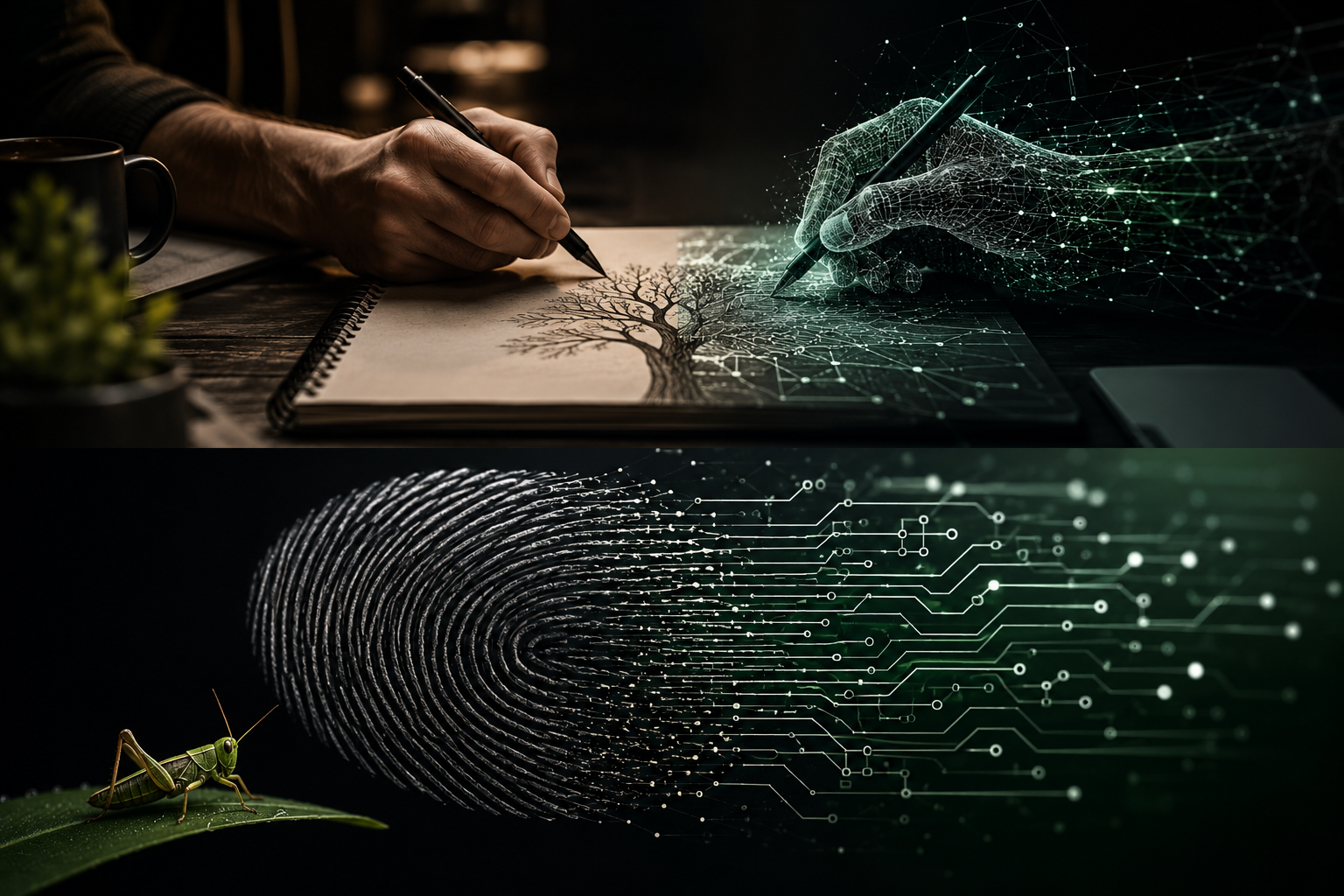
AI Can Make You Better at Your Job. It Shouldn’t Do Your Job for You.
I use AI. A lot.
And the more I use it, the more convinced I become that the conversation around AI is often focused on the wrong question.
“Will AI replace people?”
I think a much better question is: What can people accomplish when they learn how to use AI well?
AI can help research an unfamiliar subject. It can organize a mess of thoughts into something coherent. It can help troubleshoot a problem, brainstorm possibilities, explain something from a different angle, or take an idea that’s been rattling around in your head and help you figure out what to do with it.
What it cannot bring to the table is your experience.
It doesn’t have your judgment, your history, your instincts, your relationships, your sense of humor, your taste, or the years you spent learning what you know.
And it certainly shouldn’t be given the final say simply because it produced an answer confidently.
I question AI. I disagree with it. I double-check it. Sometimes I tell it that its idea is terrible. 😄
But I also learn from it.
That’s where I think the real value of AI lives.
The goal isn’t to remove the human from the process. It’s to give the human better tools.
Used poorly, AI can make everything sound remarkably similar.
Used thoughtfully, it can help a human being become faster, more capable, more creative, and sometimes even better at something they already know how to do.
Human first. AI assisted.
And I think we’re only beI use artificial intelligence almost every day.
Not because I want it to do my thinking for me. Quite the opposite. I’ve discovered that when I use AI well, I ask more questions, explore more possibilities, learn faster, and sometimes understand my own work better than I did before.
That’s an important distinction, because there is a right way and a very wrong way to use this technology.
And I’ve seen plenty of the wrong way.
AI Is Very Good at Sounding Like It Knows the Answer
Here’s a scenario that plays out constantly in technical work.
Something isn’t working. Maybe it’s a website, an email account, a form, a domain, or another piece of technology.
Someone explains the problem to an AI and asks, “What’s wrong?”
AI responds with a beautifully organized explanation of what could be wrong.
And suddenly, “could be” becomes “is.”
That’s the problem.
Artificial intelligence can take the information you give it and identify possible explanations. It can teach you what different settings do. It can help you understand terminology. It can suggest questions you haven’t thought to ask.
What it usually cannot do is see the entire environment you’re working in.
It doesn’t automatically know what settings are actually configured, what changed yesterday, what another service is doing behind the scenes, what permissions exist, or what someone forgot to mention when describing the problem.
Give AI incomplete information and it will still try to give you a complete answer.
That’s incredibly useful when you understand what you’re looking at.
It’s incredibly frustrating when you don’t.
Use AI to Investigate, Not to Declare
Suppose a website suddenly stops sending contact-form notifications.
You could ask AI:
“Why aren’t my website forms sending email?”
You’ll probably get a list of potential causes.
SMTP configuration. Authentication. DNS records. Plugin settings. Server issues. Spam filtering. Maybe several other possibilities.
That’s useful.
What’s not useful is grabbing one possibility from that list and deciding:
“AI says my DNS is broken.”
It doesn’t know that yet.
A much better next question is:
“How can I determine whether DNS is actually causing this?”
Now you’re using AI differently.
You’re not asking it to make the decision for you. You’re asking it to help you understand how to investigate the problem yourself.
That is an enormous difference.
Make AI Explain Things to You
One of my favorite uses for AI is remarkably simple:
Teach me.
If I encounter something unfamiliar, I can ask what it means.
Then I can ask why it works that way.
Then I can ask what would happen if I changed it.
Then I can challenge the answer.
“Why?”
“What else could cause that?”
“How would I verify it?”
“What am I overlooking?”
“Explain that differently.”
Those questions don’t remove me from the process. They put me deeper into it.
And occasionally I already know enough about the subject to realize the AI is wrong.
That’s useful too.
Because AI isn’t supposed to be the authority in the room.
Your Experience Still Matters
This is where I think conversations about artificial intelligence sometimes go sideways.
We talk about AI as though there are only two possibilities:
It replaces humans.
Or humans reject it.
There’s an enormous amount of territory between those two extremes.
Someone who has spent years doing a job has something AI doesn’t have: lived professional experience.
You recognize patterns.
You’ve seen weird exceptions.
You know that technically correct and practically useful aren’t always the same thing.
You know when something just doesn’t look right.
AI can give you information at extraordinary speed. But you still have to decide what that information means.
That’s where human judgment enters the equation.
Don’t Ask AI to Think Instead of You
Ask it to help you think further.
Use it to research.
Use it to brainstorm.
Use it to explain unfamiliar concepts.
Use it to organize information.
Use it to challenge your assumptions.
Use it to identify possibilities you might have missed.
And then use your own brain.
Question the answer. Verify important information. Compare what you’re being told with what you’re actually seeing. Give the AI more context. Correct it when necessary.
If something doesn’t make sense, don’t assume you’re the one who’s wrong simply because the machine sounded confident.
Ask another question.
The Human Should Still Be Driving
I don’t believe AI makes human knowledge less valuable.
I think it can make knowledgeable people considerably more capable.
But only if we resist the temptation to hand over the steering wheel.
AI can sit beside you.
It can help read the map.
It can point out another route.
It can even tell you that you may have missed a turn.
But ultimately?
You’re still driving.
And learning how to do that well may be one of the most valuable professional skills we develop in the years ahead.
Human first. AI assisted.